How Lawyers Can Help in Voter List Dispute (SIR) in West Bengal
May 3, 2026 | by Increeda Law Firm
📌 Introduction
The Special Intensive Revision (SIR) in West Bengal has led to a surge in voter disputes, including wrongful deletions, incorrect entries, and rejection of applications.
While the process is managed by the Election Commission of India, many citizens face legal complexities that require professional assistance.
👉 This is where experienced lawyers play a critical role in protecting your voting rights.
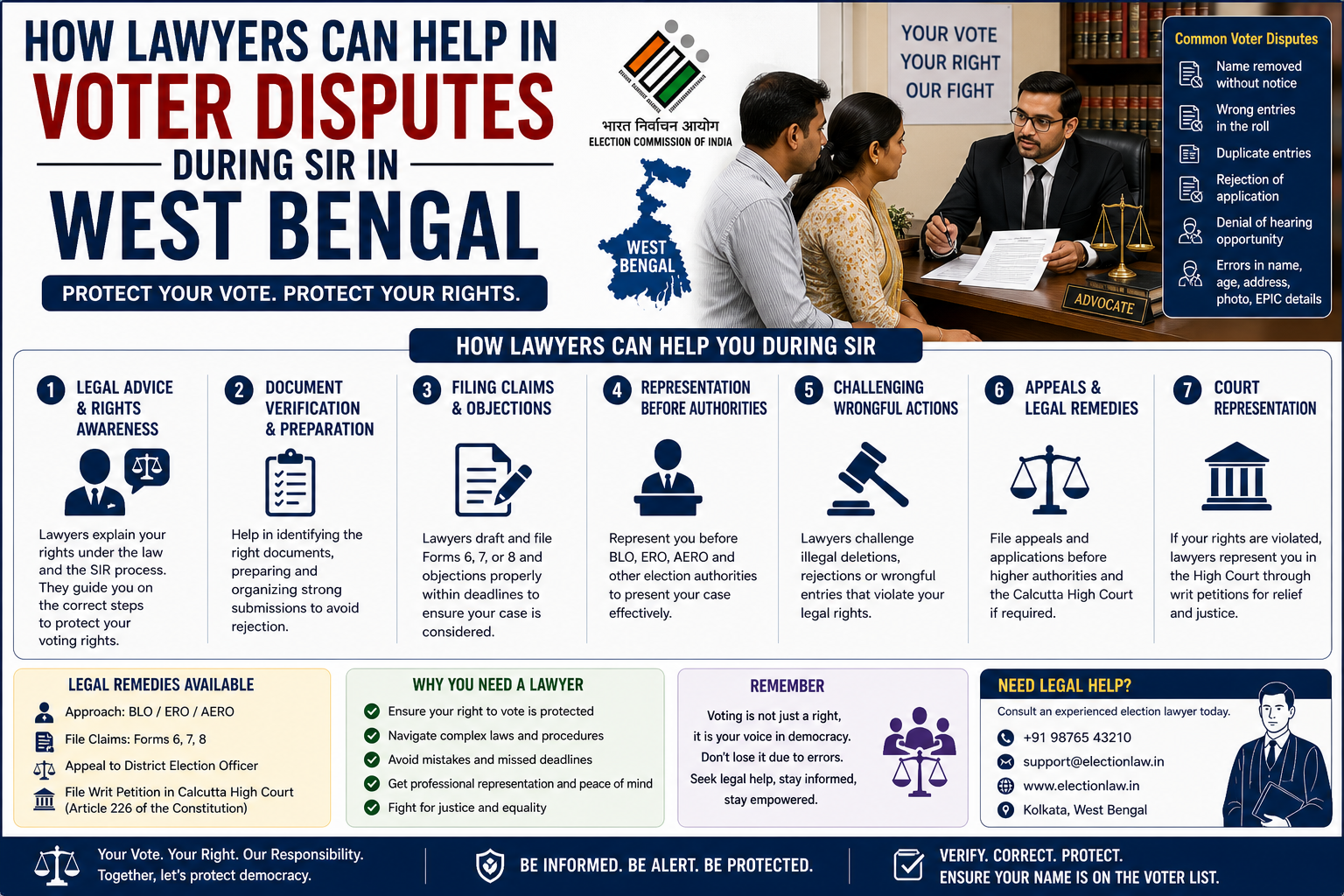
⚖️ What Are Common Voter Disputes During SIR?
During SIR, citizens often face:
- ❌ Name removed without notice
- ❌ Incorrect details in voter list
- ❌ Duplicate entries
- ❌ Rejection of Form 6, 7, or 8
- ❌ Denial of hearing opportunity
- ❌ Errors in age, address, or identity
👉 These issues can directly impact your right to vote.
🧠 Why Legal Assistance is Important
Voter disputes involve:
- Legal procedures
- Documentation requirements
- Strict deadlines
👉 A lawyer ensures:
- Compliance with law
- Proper representation
- Faster resolution
🏛️ How Lawyers Help in Voter Disputes
🟢 1. Legal Advice & Rights Awareness
Lawyers explain:
- Your rights under election laws
- Correct procedure to follow
🟢 2. Document Verification & Preparation
They help:
- Identify correct documents
- Avoid rejection due to errors
🟢 3. Filing Claims & Objections
Lawyers assist in:
- Filing Form 6 (inclusion)
- Filing Form 7 (objection/deletion)
- Filing Form 8 (correction)
👉 Proper drafting increases chances of approval.
🟢 4. Representation Before Authorities
Lawyers represent you before:
- Booth Level Officer (BLO)
- Electoral Registration Officer (ERO)
- Assistant Electoral Registration Officer (AERO)
🟢 5. Challenging Wrongful Actions
If your name is deleted unfairly:
- Lawyers challenge illegal decisions
- Ensure due process is followed
🟢 6. Appeals & Higher Remedies
Lawyers file:
- Appeals before election authorities
- Applications before district officials
🟢 7. Court Representation
In serious cases, lawyers approach:
- Calcutta High Court
👉 Filing writ petitions under Article 226 for:
- Restoration of voter name
- Protection of rights
⚖️ Legal Grounds Lawyers Use
Lawyers rely on:
- Article 14 – Equality before law
- Article 21 – Right to life and dignity
- Representation of the People Act, 1950
- Principles of natural justice
⚠️ Situations Where You MUST Consult a Lawyer
- Your name is deleted without notice
- Your application is repeatedly rejected
- You are denied a hearing
- Elections are near and urgent action is needed
👉 Delay can permanently affect your voting rights.
🧠 Benefits of Hiring a Lawyer
✔ Professional guidance
✔ Faster resolution
✔ Strong legal representation
✔ Reduced chances of rejection
✔ Protection of constitutional rights
🏢 Role of Law Firms in Kolkata
Law firms like Increeda Law Firm assist in:
- Electoral disputes
- High Court litigation
- Urgent voter rights cases
👉 Especially important during mass SIR-related disputes.
❓ Frequently Asked Questions (FAQ)
Q1. Can a lawyer restore my deleted voter name?
👉 Yes, through legal remedies and court action.
Q2. Is it necessary to hire a lawyer?
👉 Not mandatory, but highly recommended in complex cases.
Q3. How fast can a lawyer resolve the issue?
👉 Depends on urgency—court cases can be expedited.
Q4. Can I go directly to High Court?
👉 Yes, under Article 226.
Q5. What is the cost?
👉 Varies depending on complexity.
🧾 Conclusion
The SIR process in West Bengal has made voter list verification stricter—but also more legally complex.
👉 If you are facing any voter dispute, a lawyer can:
- Protect your rights
- Ensure fair process
- Help restore your voting eligibility
Your vote is your voice—don’t lose it due to procedural errors.
Get in Touch with The Best Lawyer & Law Firm in Kolkata
If you are looking for professional legal guidance, court representation, or urgent legal assistance, contact Increeda Law Firm today. Our experienced advocates handle matters before the Supreme Court of India, Calcutta High Court, Bankshal Court, City Civil Court, Alipore Court, Sealdah Court, and District Courts across West Bengal.
We provide consultation for:
- Calcutta High Court assistance for SIR matters
- SIR Advocate for Calcutta High Court
- SIR Advocate for Calcutta High Court
- legal options after an adverse electoral-roll decision
- Legal Help after Tribunal appeal (SIR Name Deletion) West Bengal- Complete Guide 2026
- voter-name restoration guide
- Wrongful Deletion of Voter Name During Electoral Roll Revision – West Bengal
- How to File a Claim for Re-Inclusion of Name in West Bengal Voter List after SIR Deletion
- Special Intensive Revision (SIR) in West Bengal 2026. What to Do If Your Name Is Missing from the Electoral Roll?
- Name Removed During SIR in West Bengal
- Legal Consultant for New Businesses – Increeda Law Firm
- Best Corporate Legal Advisor in Kolkata
- Best Business Legal Consultant in Kolkata
- Top 10 Lawyer for SIR & Voter Rights Cases in High Court
Important Link
- Sulekha
- Just Dail
- Government legal resources
- Divorce & Family Lawyer in Kolkata – Best Divorce & Family Lawyer | Increeda Law Firm
- Legal research websites
- Law journals and educational portals
- Bar Council legal guidelines
- Indian judiciary legal resources
- eCourt Service
📍 Office Address
Increeda Law Firm (Inc Law Firm)
Kolkata, West Bengal, India
Primary Location:
Near Calcutta High Court & City Civil Court, Kolkata
South Kolkata Chamber:
41/C, Bikramgarh, Near South City Mall
Strategically located near major courts and commercial hubs, making it convenient for High Court, Civil Court, and district court matters.
📞 Contact Details
Phone: +91-9433820692
Email:
info@increedalawfirm.com
increedalawfirm@gmail.com
Website:
➡ Increeda Law Firm – Official Website
RELATED POSTS
View all