Can a Deleted Voter Name Be Restored After a Tribunal Decision?
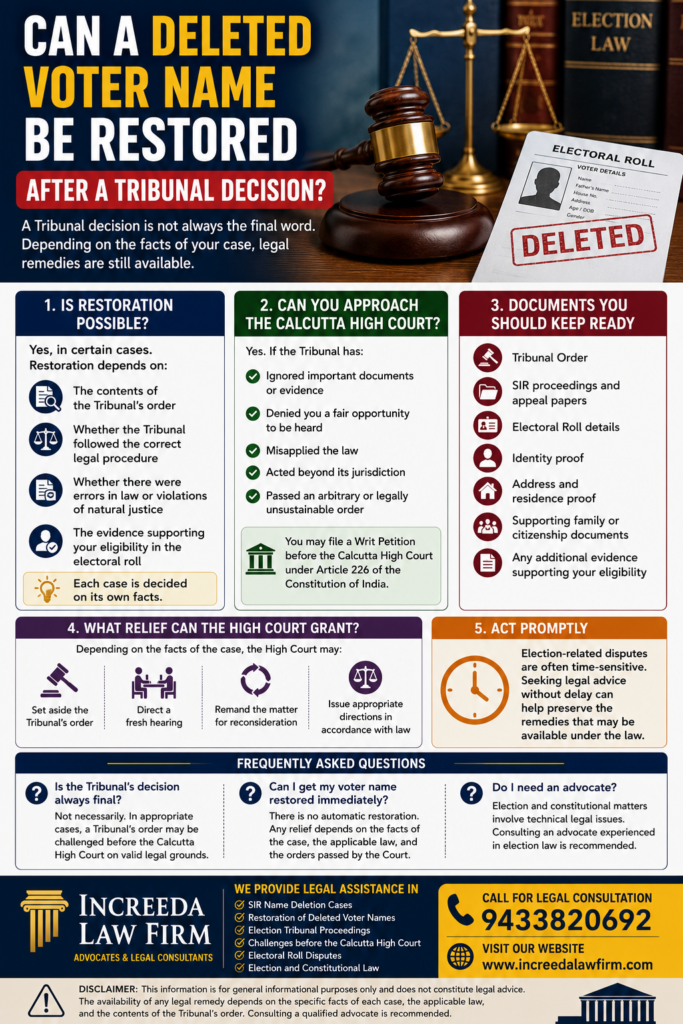
If your voter name has been deleted during the Special Intensive Revision (SIR) process and the Election Tribunal has already passed an order, you may still have legal options depending on the facts of your case. A tribunal decision does not automatically mean that every legal remedy has been exhausted.
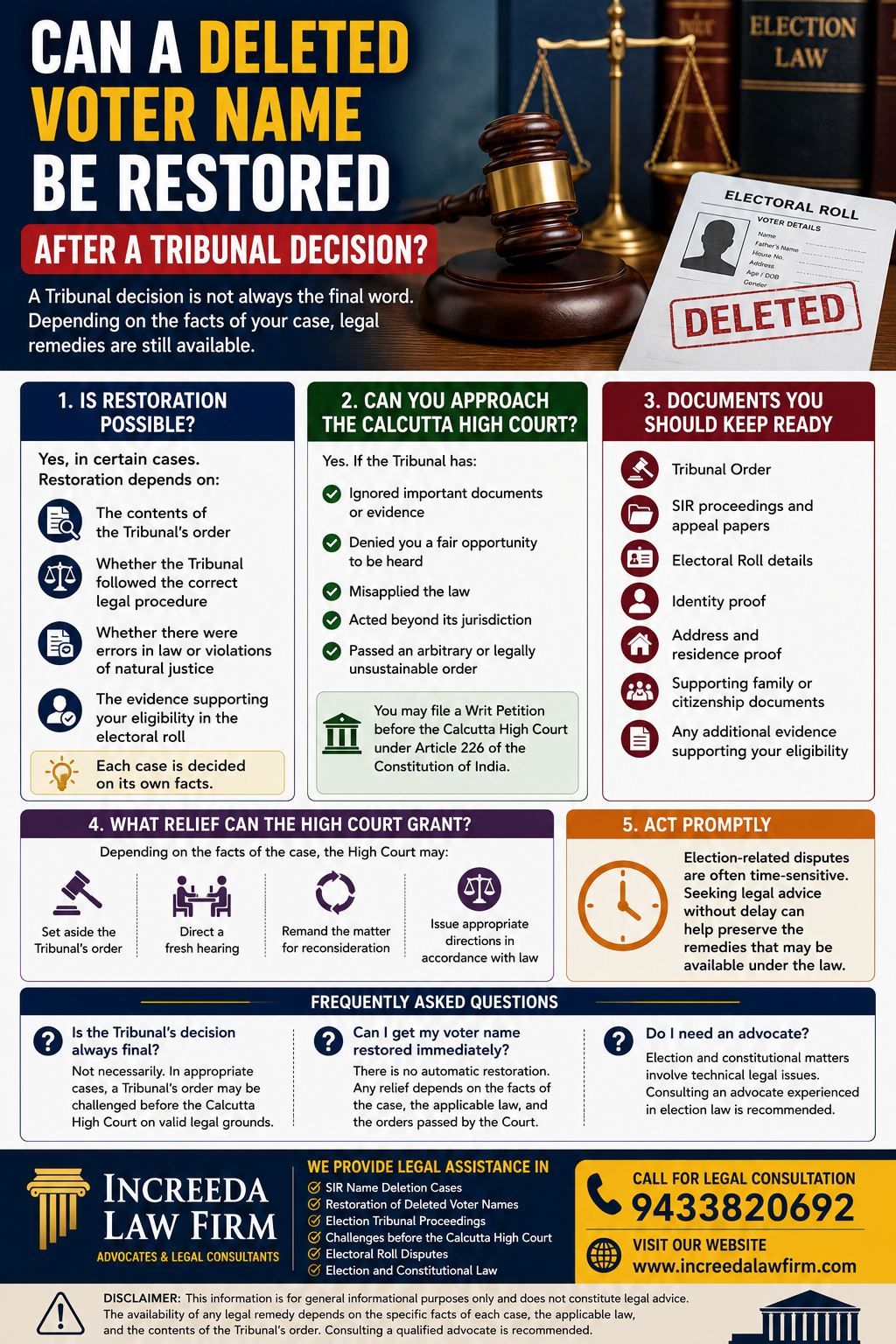
Is Restoration Possible After a Tribunal Decision?
In certain cases, yes. Whether your name can be restored depends on:
- The contents of the Tribunal’s order.
- Whether the Tribunal followed the correct legal procedure.
- Whether there were errors in law or violations of natural justice.
- The evidence supporting your eligibility to be included in the electoral roll.
Each case is decided on its own facts.
Can You Approach the Calcutta High Court?
If you believe the Tribunal has:
- Ignored important documents or evidence,
- Denied you a fair opportunity to be heard,
- Misapplied the law,
- Acted beyond its jurisdiction, or
- Passed an arbitrary or legally unsustainable order,
you may be able to file a Writ Petition before the Calcutta High Court under Article 226 of the Constitution of India, seeking judicial review of the Tribunal’s decision.
Documents You Should Keep Ready
Before consulting an advocate, keep the following documents available:
- Tribunal Order
- SIR proceedings and appeal papers
- Electoral Roll details
- Identity proof
- Address and residence proof
- Supporting family or citizenship documents, where applicable
- Any additional evidence supporting your eligibility
What Relief Can the High Court Grant?
Depending on the facts of the case, the High Court may:
- Set aside the Tribunal’s order.
- Direct a fresh hearing.
- Remand the matter for reconsideration.
- Issue appropriate directions in accordance with law.
The Court’s decision will depend on the merits of the individual case.
Why You Should Act Promptly
Election-related disputes are often time-sensitive. Seeking legal advice without unnecessary delay can help preserve the remedies that may be available under the law.
Frequently Asked Questions
Is the Tribunal’s decision always final?
Not necessarily. In appropriate cases, a Tribunal’s order may be challenged before the Calcutta High Court on valid legal grounds.
Can I get my voter name restored immediately?
There is no automatic restoration. Any relief depends on the facts of the case, the applicable law, and the orders passed by the competent court.
Do I need an advocate?
Election and constitutional matters involve technical legal issues. Consulting an advocate experienced in election law is generally recommended.
Need Legal Assistance?
Increeda Law Firm provides legal assistance in matters relating to:
- SIR Name Deletion Cases
- Restoration of Deleted Voter Names
- Election Tribunal Proceedings
- Challenges before the Calcutta High Court
- Electoral Roll Disputes
- Election and Constitutional Law
📞 Call for Legal Consultation: +91 9433820692
🌐 Website: https://increedalawfirm.com
Disclaimer
This article is for general informational purposes only and does not constitute legal advice. The availability of any legal remedy depends on the specific facts of each case, the applicable law, and the contents of the Tribunal’s order. Consulting a qualified advocate is recommended before initiating legal proceedings.