
Name Deleted from Voter List? What to Do First
May 15, 2026 | by Increeda Law Firm
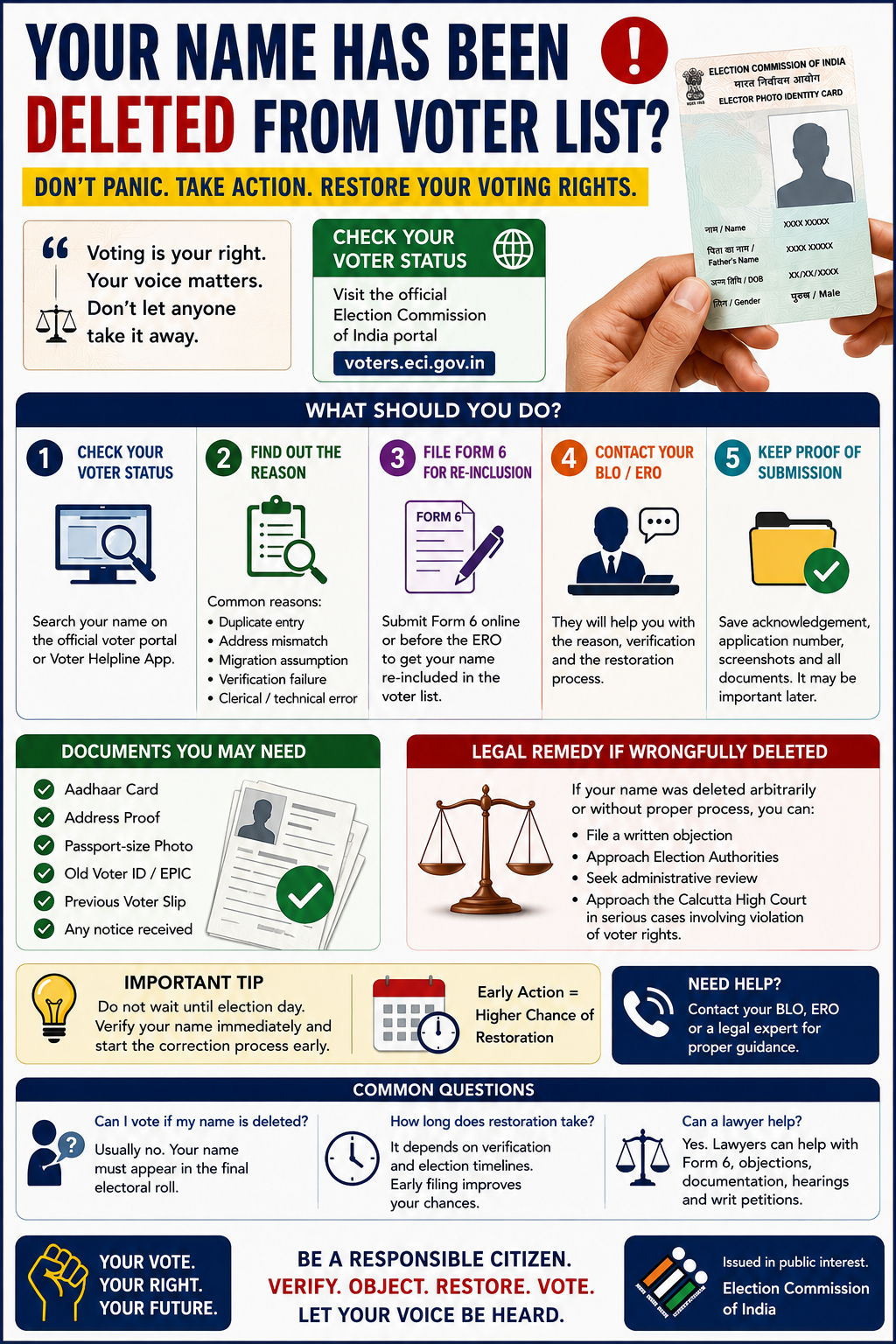
What Happens If Your Name Is Missing or Deleted From the Voter List?
Discovering that your name is missing from an electoral roll can be alarming, particularly near an election. The first step is to establish exactly what the current roll records. A voter identity card or EPIC number is evidence of earlier registration, but it does not by itself permit voting if the person’s name does not appear in the electoral roll being used for that election.
A missing search result does not always establish the reason. The entry may have been omitted, deleted, shifted to another part or constituency, recorded with different particulars, or affected by an application or decision that is still being processed. The appropriate response depends on the present status, the stage of revision and whether an order or notice already exists.
First, Verify the Current Electoral-Roll Status
Check the current electoral roll for the relevant constituency and polling part, using more than one search method where available. Search by EPIC details and by name and address, allowing for spelling variations. If the person recently moved, also check the previous and present constituency records.
- Record the roll version, publication date, constituency and part number checked.
- Save a screenshot, downloaded extract or written search result showing the date of the check.
- Compare the current result with an earlier electoral-roll entry, voter slip or EPIC record.
- Ask the Booth Level Officer or Electoral Registration Officer’s office to confirm the recorded status and the reason available in its records.
The electoral-roll revision process in West Bengal explains how draft publication, claims, verification, decisions and final publication relate to one another.
Understand the Immediate Voting Consequence
Possession of an EPIC card does not replace inclusion in the applicable electoral roll. If the name is absent from the roll used at the polling station, presenting the card alone ordinarily will not create an entitlement to vote. An application, acknowledgement or pending request also does not itself establish that the name has already been included.
For that reason, verify the roll before polling day and retain proof of every submission. Whether any corrective step can affect a particular election depends on the applicable roll, the procedural stage and the official schedule; no fixed completion time should be assumed.
Collect the Records Before Taking the Next Step
Preserve the available record before submitting a fresh request or challenging an existing decision. Useful material may include:
- the current search result or relevant electoral-roll extract;
- an earlier roll entry, voter slip and EPIC details;
- any notice, hearing communication, verification record or written decision;
- copies of applications and documents already submitted;
- online or offline acknowledgement, reference numbers and submission dates;
- records showing the person’s identity, age and ordinary residence, as relevant;
- correspondence with the BLO, ERO or other identified electoral authority.
Keep originals safely and submit copies where the procedure permits. Do not alter an inconsistent record to make it appear uniform. Note the inconsistency and preserve documents that explain it.
Check for a Notice, Hearing or Existing Decision
Ask whether any notice was issued, whether a verification report exists and whether an order or recorded reason is available. The next procedure can differ significantly depending on whether the entry is simply absent, a request remains pending, an objection is being considered, or an authority has already made an adverse decision.
Where notice, participation, evidence or hearing issues arise, review the procedural safeguards during electoral-roll revision. The existence and effect of any safeguard or remedy must be assessed under the governing provision and the facts of the individual matter.
Take the Appropriate First Administrative Step
If the name is missing and no adverse decision controls the matter, an inclusion or re-inclusion procedure may be appropriate. If the problem concerns particulars in an existing entry, a correction procedure may instead be required. An objection to another entry is different from seeking inclusion or correcting one’s own details.
If an application has already been rejected or a formal decision exists, repeatedly filing the same request may not address that decision. The applicable statutory or appellate step should be identified from the order, governing framework and procedural stage. The detailed guide to seeking re-inclusion after SIR deletion explains the restoration process and the importance of choosing the procedure that matches the person’s status.
Preserve Proof of Every Follow-Up
- Keep the acknowledgement or reference number for each submission.
- Record the date, office and method of submission.
- Save uploaded files and screenshots of online status pages.
- Keep copies of notices and note hearing dates accurately.
- Request a written decision or recorded reason where the applicable procedure provides for one.
- Maintain a short chronological timeline of events and communications.
Verbal assurances are difficult to verify later. Written records help an electoral authority or legal adviser understand what has already happened and avoid unnecessary duplicate filings.
When Case-Specific Advice May Be Necessary
Individual advice may be useful where the records conflict, an adverse order exists, a hearing was missed, the person cannot identify the applicable procedure, or the authority has not acted on a documented submission. Any further remedy, including court proceedings, depends on the governing law, available statutory remedies, maintainability and the facts. No outcome or completion date can be guaranteed.
Immediate Checklist
- Confirm the current roll and constituency.
- Save proof of the search result.
- Locate earlier roll entries and EPIC details.
- Obtain notices, acknowledgement and any decision.
- Ask the relevant electoral office to confirm the recorded status.
- Choose the procedure that matches that status and stage.
- Keep proof of submission and monitor official communications.
RELATED POSTS
View all

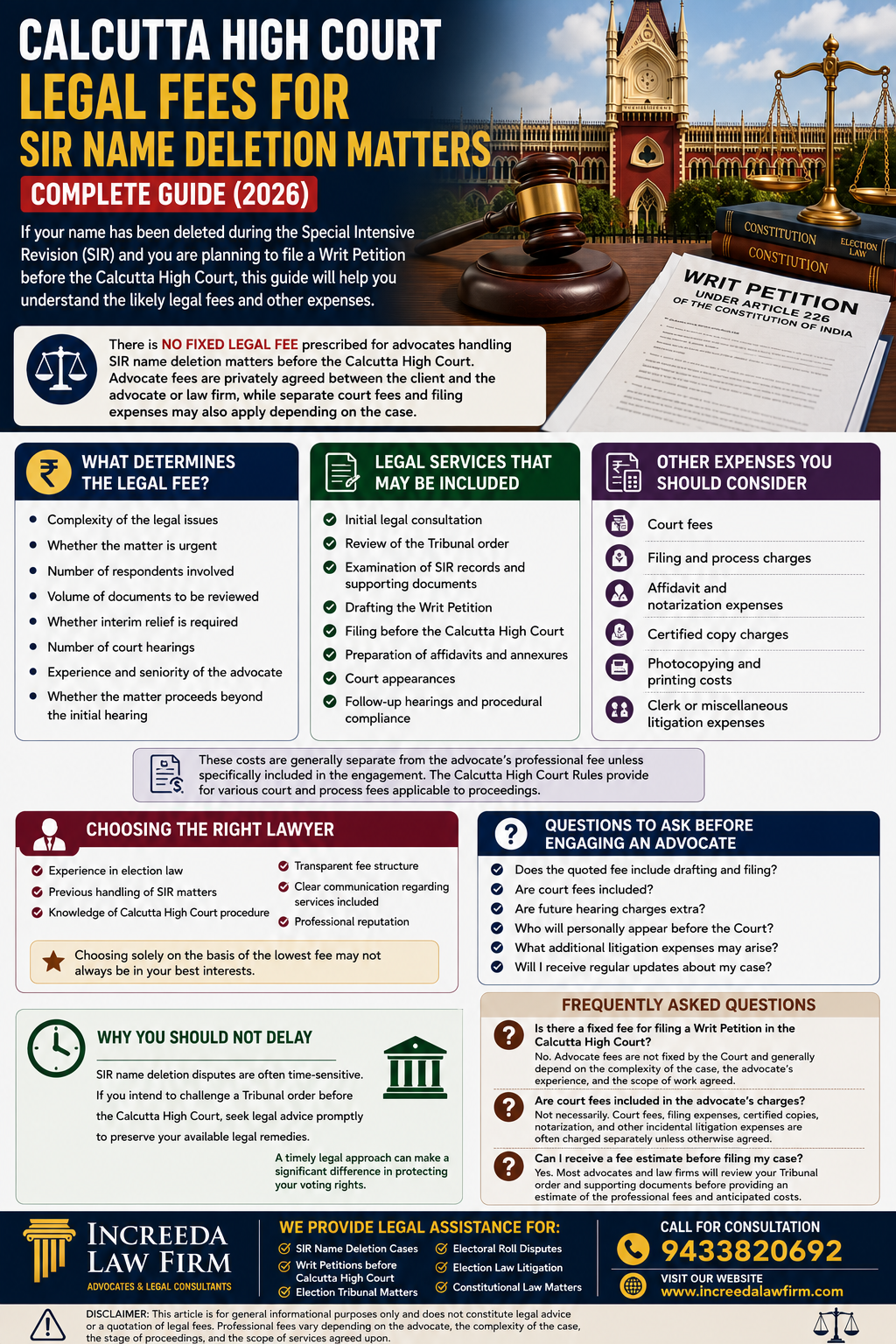
Calcutta High Court Legal Fees for SIR Name Deletion Matters – Complete Guide (2026)
July 22, 2026 | by Increeda Law Firm

How to Handle Property Disputes in Kolkata – Legal Guide (2026 Updated)
February 27, 2026 | by Increeda Law Firm

SIR Name Deletion Lawyer Fees in Kolkata 2026 | Complete Guide
July 22, 2026 | by Increeda Law Firm