
Trusted Business Legal Consultant for Companies, Entrepreneurs & Growing Enterprises
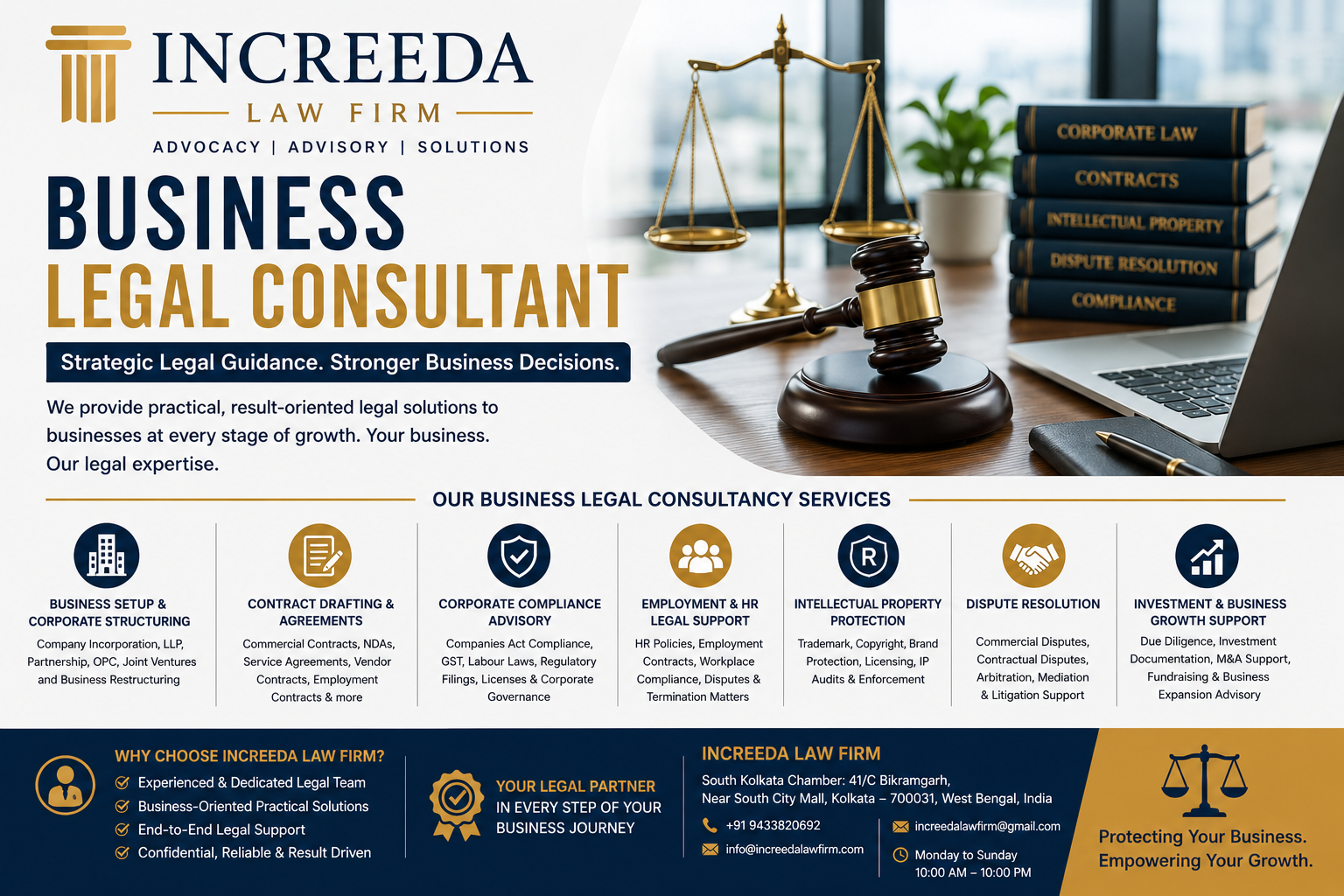
In today's competitive business environment, legal compliance and strategic legal planning are essential for long-term success. Whether you are a startup, SME, private limited company, partnership firm, or established corporation, professional legal guidance helps protect your business interests, reduce risks, and support sustainable growth.
At Increeda Law Firm, we provide comprehensive Business Legal Consultancy Services designed to help businesses navigate complex legal challenges, regulatory requirements, contractual obligations, and commercial transactions with confidence.
Why Businesses Need a Legal Consultant
Every business faces legal issues at different stages of growth. From company formation and contract management to dispute resolution and regulatory compliance, having a dedicated legal consultant can help prevent costly mistakes and protect business assets.
Our Business Legal Consultants assist with:
- Business Formation & Structuring
- Corporate Compliance
- Contract Drafting & Review
- Commercial Transactions
- Employment Law Matters
- Intellectual Property Protection
- Business Dispute Resolution
- Regulatory Compliance
- Investment & Funding Support
- Risk Management Strategies
Our Business Legal Consultancy Services
Business Formation & Corporate Structuring
We help entrepreneurs and companies establish the most suitable legal structure, including:
- Private Limited Companies
- LLP Registration
- Partnership Firms
- One Person Companies (OPC)
- Sole Proprietorships
- Joint Ventures
- Business Expansion Structuring
Contract Drafting & Commercial Agreements
Well-drafted agreements are essential for protecting business interests.
We prepare and review:
- Service Agreements
- Vendor Contracts
- Client Agreements
- Partnership Agreements
- Joint Venture Agreements
- Consultancy Agreements
- Non-Disclosure Agreements (NDA)
- Employment Contracts
- Shareholder Agreements
Corporate Compliance Advisory
Our compliance services help businesses remain legally secure and operationally efficient.
We provide guidance on:
- Companies Act Compliance
- Corporate Governance
- Labour Law Compliance
- GST Compliance
- Regulatory Filings
- Business Licensing Requirements
- Industry-Specific Compliance
Employment & HR Legal Support
We assist employers with:
- Employment Agreements
- HR Policies
- Employee Handbooks
- Workplace Compliance
- Confidentiality Agreements
- Termination Procedures
- Employment Dispute Management
Intellectual Property Protection
Business success often depends on protecting valuable intellectual assets.
Our services include:
- Trademark Registration
- Copyright Protection
- Brand Protection
- Licensing Agreements
- IP Enforcement Actions
- Intellectual Property Audits
Business Risk Management
We help identify legal risks before they become costly problems through:
- Legal Due Diligence
- Compliance Audits
- Contract Risk Assessment
- Regulatory Risk Analysis
- Corporate Governance Reviews
Business Dispute Resolution
When disputes arise, our legal team provides effective representation and strategic solutions.
We handle:
- Commercial Disputes
- Contractual Disputes
- Partnership Conflicts
- Shareholder Disputes
- Recovery Proceedings
- Arbitration & Mediation
- Litigation Support
Investment & Business Expansion Support
As businesses grow, legal planning becomes increasingly important.
We assist with:
- Investment Documentation
- Share Subscription Agreements
- Due Diligence
- Corporate Restructuring
- Mergers & Acquisitions Support
- Strategic Business Transactions
Why Choose Increeda Law Firm?
Experienced Business Lawyers
Our legal professionals understand both the legal and commercial realities faced by modern businesses.
Practical Commercial Solutions
We focus on business-friendly legal advice that supports growth while minimizing risk.
Comprehensive Legal Support
From incorporation to expansion, we provide end-to-end legal assistance.
Cost-Effective Advisory Services
We offer practical legal solutions tailored to the needs of startups, SMEs, and large enterprises.
Industries We Serve
- Technology Companies
- Startups
- Manufacturing Businesses
- E-Commerce Companies
- Real Estate Enterprises
- Healthcare Organizations
- Educational Institutions
- Hospitality Businesses
- Professional Service Firms
- Retail & Trading Companies
Contact Increeda Law Firm
Increeda Law Firm
South Kolkata Chamber: 41/C Bikramgarh, Near South City Mall, Kolkata
Phone: +91 9433820692
Email: info@increedalawfirm.com
Alternative Email: increedalawfirm@gmail.com
Strategic Legal Solutions for Business Success
At Increeda Law Firm, our Business Legal Consultants provide practical legal guidance, proactive risk management, and comprehensive business support to help organizations operate confidently and achieve long-term success.
Get in Touch with The Best Lawyer & Law Firm in Kolkata
If you are looking for professional legal guidance, court representation, or urgent legal assistance, contact Increeda Law Firm today. Our experienced advocates handle matters before the Supreme Court of India, Calcutta High Court, Bankshal Court, City Civil Court, Alipore Court, Sealdah Court, and District Courts across West Bengal.
We provide consultation for:
- The Best Calcutta High Court Lawyer
- Best Lawyer in Kolkata
- The Best Civil Lawyer in Kolkata The Best Criminal Lawyer in Kolkata'
- Best Divorce & Family Lawyer in Kolkata
- Best Original Side Lawyer in Kolkata
- Property Dispute Lawyer in Kolkata
- Top Cyber Crime Lawyer in Kolkata
- Best original Side Lawyer in Kolkata
- Cyber Crime FIR Process in India
- Cyber Crime FIR Process in West Bengal
- Property dispute legal guidance
- Best Calcutta High Court Lawyer – How to Choose the Right Advocate
- How to Handle Property Disputes in Kolkata
- Latest Property Registration Guide in West Bengal (2026 Updated)
Important Link