




Anticipatory Bail Process in India is an important legal remedy available to individuals who fear arrest in a criminal case. It is a preventive relief granted by a court to protect a person from being taken into custody before trial. The concept is designed to safeguard personal liberty and prevent misuse of arrest powers by law enforcement authorities.
Under Section 438 of the Code of Criminal Procedure (CrPC), a person who apprehends arrest in a non-bailable offence may apply to the appropriate court seeking anticipatory bail. Once granted, the applicant cannot be arrested by the police for that particular offence without following the conditions set by the court.
For individuals facing criminal allegations in cities like Kolkata, understanding the anticipatory bail process in India is essential to protect legal rights and freedom.
What is Anticipatory Bail?

Anticipatory bail is a pre-arrest bail granted by a court when a person believes that they may be falsely implicated in a criminal case or that the police may arrest them.
Unlike regular bail, which is sought after arrest, anticipatory bail is filed before the arrest happens.
Legal Provision
The provision for anticipatory bail is found in:
Section 438 of the Code of Criminal Procedure (CrPC).
The section allows a person to apply to:
- Sessions Court
- High Court
for protection against arrest.
Courts consider various factors before granting relief, such as:
- Nature of the accusation
- Criminal history of the applicant
- Possibility of fleeing from justice
- Whether accusations appear malicious or politically motivated
When Should You Apply for Anticipatory Bail?
You should consider applying for anticipatory bail when:
✔ You believe a false FIR may be lodged against you
✔ A criminal complaint has already been filed
✔ Police are attempting to arrest you
✔ There is family, business, or property dispute litigation that may lead to criminal allegations
✔ A cyber crime complaint or financial offence case has been registered
In cities like Kolkata, anticipatory bail applications are commonly filed in cases such as:
- Domestic disputes
- Financial fraud allegations
- Cyber crime complaints
- Property disputes
- Business conflicts
Step-by-Step Process to Get Anticipatory Bail in India
Step 1: Consult a Criminal Lawyer
The first step is to consult an experienced criminal lawyer who can analyze the FIR or complaint.
The lawyer will examine:
- FIR details
- Sections of IPC invoked
- Evidence available
- Police investigation stage
A strong legal strategy is crucial because anticipatory bail applications require detailed legal arguments.
Step 2: Drafting the Anticipatory Bail Application
Your lawyer prepares a bail petition containing:
- Applicant’s details
- FIR number and police station
- Sections of law invoked
- Grounds for seeking anticipatory bail
- Reasons why arrest is unnecessary
Typical legal grounds include:
- False implication
- Civil dispute wrongly converted into criminal case
- No criminal history
- Willingness to cooperate with investigation
Supporting documents may include:
- FIR copy
- Complaint copy
- Identity proof
- Supporting evidence
Step 3: Filing the Application in Court
The anticipatory bail petition is filed before:
Sessions Court
or
High Court
In Kolkata, such petitions are typically filed in courts such as:
- City Sessions Court
- Alipore Court
- Sealdah Court
- Calcutta High Court
Generally, the Sessions Court is approached first, and if rejected, the applicant may approach the High Court.
Step 4: Court Hearing
During the hearing:
The defense lawyer argues:
- The arrest is unnecessary
- The applicant will cooperate with investigation
- The case may be based on false allegations
The public prosecutor representing the police may oppose the bail.
The judge evaluates:
- Evidence presented
- Nature of offence
- Criminal background of applicant
- Possibility of tampering with evidence
Step 5: Interim Protection (Sometimes Granted)
In many cases, the court grants interim anticipatory bail.
This means:
- The applicant cannot be arrested temporarily
- The court asks the police to respond
- A final hearing date is fixed
Interim protection is common in complex criminal disputes.
Step 6: Final Court Order
After hearing both sides, the court may:
Grant Anticipatory Bail
or
Reject the Application
If granted, the court may impose conditions.
Conditions Usually Imposed by Courts
Courts often impose conditions such as:
- The accused must cooperate with police investigation
- The accused must not threaten witnesses
- The accused must not leave India without permission
- The accused must appear before police when required
Failure to follow these conditions can lead to cancellation of bail.
What Happens After Anticipatory Bail is Granted?
Once anticipatory bail is granted:
✔ Police cannot arrest the accused in that case
✔ The accused may be asked to join investigation
✔ If arrest becomes necessary, the accused must be released immediately on bail
The bail usually remains effective until the end of trial, unless cancelled.
Can Anticipatory Bail Be Rejected?
Yes. Courts may reject anticipatory bail in serious offences such as:
- Murder cases
- Rape allegations
- Terrorism cases
- Major financial fraud
- Organized crime
If rejected by the Sessions Court, the applicant may file a fresh petition in the High Court.
Important Supreme Court Guidelines on Anticipatory Bail
The Supreme Court has clarified several principles regarding anticipatory bail.
Key points include:
- Anticipatory bail can continue till the end of trial
- Courts must protect personal liberty
- Arrest should not be used as a tool of harassment
- Each case must be decided based on its facts and circumstances
These guidelines ensure that anticipatory bail remains a powerful protection against misuse of criminal law.
Common Cases Where Anticipatory Bail is Filed
Some of the most frequent anticipatory bail cases include:
Matrimonial Disputes
Cases under domestic violence or cruelty allegations.
Property Disputes
Civil property conflicts turning into criminal complaints.
Business Disputes
Financial disagreements between partners.
Cyber Crime Allegations
Online fraud or harassment accusations.
Political or Personal Rivalries
False complaints due to personal conflicts.
Documents Required for Anticipatory Bail
Typically required documents include:
- FIR copy
- Complaint copy
- Applicant ID proof
- Address proof
- Evidence supporting innocence
- Lawyer’s vakalatnama
Providing proper documentation helps strengthen the application.
Importance of Hiring an Experienced Criminal Lawyer
Anticipatory bail applications require precise legal arguments and understanding of criminal procedure.
A skilled criminal lawyer can:
- Analyze the FIR and charges
- Prepare strong legal grounds
- Represent the case effectively in court
- Secure interim protection if needed
Professional legal representation significantly improves the chances of getting bail.
Anticipatory Bail in Kolkata Courts
In Kolkata and West Bengal, anticipatory bail petitions are commonly filed in:
- Sessions Courts
- District Courts
- High Court
Courts evaluate each case carefully to balance individual liberty and investigation requirements.
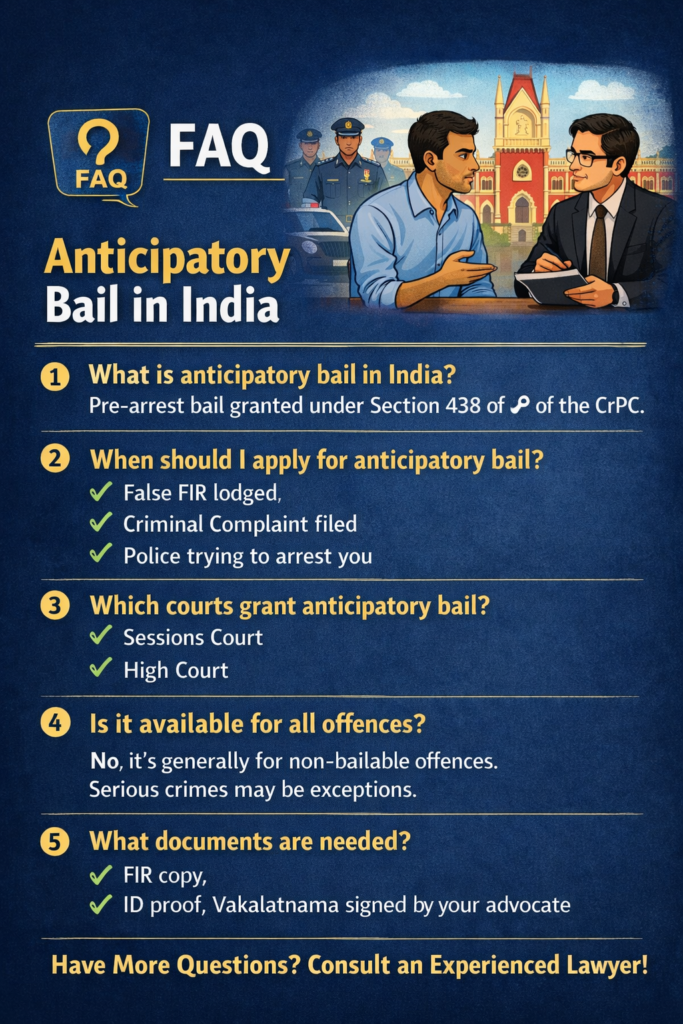
FAQ – Anticipatory Bail Process in India
1. What is anticipatory bail in India?
Anticipatory bail is a legal protection granted by a court before arrest. Under Section 438 of the Code of Criminal Procedure (CrPC), a person who fears arrest in a non-bailable offence can apply for anticipatory bail in the Sessions Court or High Court. If granted, the police cannot arrest the person without following the conditions set by the court.
2. When should a person apply for anticipatory bail?
A person should apply for anticipatory bail when they believe that police may arrest them in a criminal case. Common situations include:
- False FIR or complaint
- Family or matrimonial disputes
- Property disputes
- Business or financial disputes
- Cyber crime allegations
- Political or personal rivalry cases
Applying early helps protect personal liberty and legal rights.
3. Which courts grant anticipatory bail in India?
Anticipatory bail can be granted by:
- Sessions Court
- High Court
Usually, the application is first filed in the Sessions Court, and if rejected, the applicant can approach the High Court.
4. Is anticipatory bail available for all offences?
No. Anticipatory bail is generally available for non-bailable offences, but courts may reject it in serious crimes such as:
- Murder
- Rape
- Terrorism
- Large financial fraud
- Organized crime
The court decides based on the nature and seriousness of the allegations.
5. What documents are required for anticipatory bail?
Typical documents required include:
- Copy of FIR or complaint
- Identity proof of the applicant
- Address proof
- Supporting evidence
- Vakalatnama signed by the advocate
These documents help the lawyer prepare a strong bail application.
6. What conditions are usually imposed in anticipatory bail?
Courts may impose several conditions, such as:
- Cooperating with police investigation
- Appearing before the investigating officer when required
- Not threatening witnesses
- Not leaving the country without court permission
Failure to follow these conditions may lead to cancellation of bail.
7. Can anticipatory bail be cancelled?
Yes. The court can cancel anticipatory bail if the accused:
- Violates court conditions
- Threatens witnesses
- Attempts to destroy evidence
- Fails to cooperate with investigation
The prosecution can file a bail cancellation application in court.
8. How long does anticipatory bail remain valid?
According to Supreme Court guidelines, anticipatory bail can remain valid until the end of trial, unless the court specifically limits its duration or cancels it due to violation of conditions.
9. What happens after anticipatory bail is granted?
Once anticipatory bail is granted:
- The accused cannot be arrested for that offence.
- The person may be asked to join investigation.
- If police attempt arrest, the accused must be released immediately on bail.
10. Can anticipatory bail be filed after FIR?
Yes. Anticipatory bail can be filed after an FIR is registered or even before arrest, as long as the applicant has a reasonable apprehension of arrest.
11. What is the difference between bail and anticipatory bail?
The main difference is timing.
Regular Bail
- Applied after arrest
Anticipatory Bail
- Applied before arrest
Anticipatory bail protects a person from being taken into custody.
12. How long does it take to get anticipatory bail?
The time depends on the court and case urgency. In many situations:
- Interim protection may be granted quickly.
- Final hearing may take a few days to a few weeks.
Urgent cases can sometimes be heard on the same day.
13. Can police oppose anticipatory bail?
Yes. The public prosecutor representing the police may oppose the bail application by arguing that:
- The offence is serious
- The accused may influence witnesses
- The accused may tamper with evidence
The court decides after hearing both sides.
14. Can anticipatory bail be filed directly in the High Court?
Yes. In certain circumstances, a person may file anticipatory bail directly in the High Court, especially when the case involves complex legal issues or urgent protection is needed.
15. Why is hiring an experienced criminal lawyer important for anticipatory bail?
An experienced criminal lawyer can:
- Analyze the FIR and evidence
- Draft strong legal arguments
- Represent the case effectively in court
- Increase the chances of getting bail
Professional legal representation is crucial in criminal defence matters.
Learn about our other services:
- The Best Calcutta High Court Lawyer
- Best Lawyer in Kolkata
- The Best Civil Lawyer in Kolkata The Best Criminal Lawyer in Kolkata‘
- Best Divorce & Family Lawyer in Kolkata
- Best Original Side Lawyer in Kolkata
- Property Dispute Lawyer in Kolkata
- Top Cyber Crime Lawyer in Kolkata
Learn more about our Civil Law Services and Criminal Law Practice for detailed legal support.
Get in Touch with The Best Lawyer & Law Firm in Kolkata
If you are looking for professional legal guidance, court representation, or urgent legal assistance, contact Increeda Law Firm today. Our experienced advocates handle matters before the Supreme Court of India, Calcutta High Court, Bankshal Court, City Civil Court, Alipore Court, Sealdah Court, and District Courts across West Bengal.
We provide consultation for:
- The Best Calcutta High Court Lawyer
- Best Lawyer in Kolkata
- The Best Civil Lawyer in Kolkata The Best Criminal Lawyer in Kolkata‘
- Best Divorce & Family Lawyer in Kolkata
- Best Original Side Lawyer in Kolkata
- Property Dispute Lawyer in Kolkata
- Top Cyber Crime Lawyer in Kolkata
- Best original Side Lawyer in Kolkata
- Cyber Crime FIR Process in India
- Cyber Crime FIR Process in West Bengal
- Property dispute legal guidance
- Best Calcutta High Court Lawyer – How to Choose the Right Advocate
- How to Handle Property Disputes in Kolkata
- Latest Property Registration Guide in West Bengal (2026 Updated)
Important Link
- Sulekha
- Just Dail
- Government legal resources
- Divorce & Family Lawyer in Kolkata – Best Divorce & Family Lawyer | Increeda Law Firm
- Legal research websites
- Law journals and educational portals
- Bar Council legal guidelines
- Indian judiciary legal resources
- eCourt Service
- Bar Council of India
https://www.barcouncilofindia.org - eCourts India
https://ecourts.gov.in - Supreme Court of India
https://main.sci.gov.in
Conclusion
Anticipatory bail is a critical legal safeguard in India that protects individuals from unnecessary arrest and harassment. By allowing a person to seek bail before arrest, the law ensures that personal freedom is not violated due to false or exaggerated allegations.
Understanding the anticipatory bail process in India can help individuals take timely legal action when facing criminal accusations. Consulting an experienced criminal lawyer and filing a properly drafted bail application significantly increases the chances of obtaining relief from the court.